
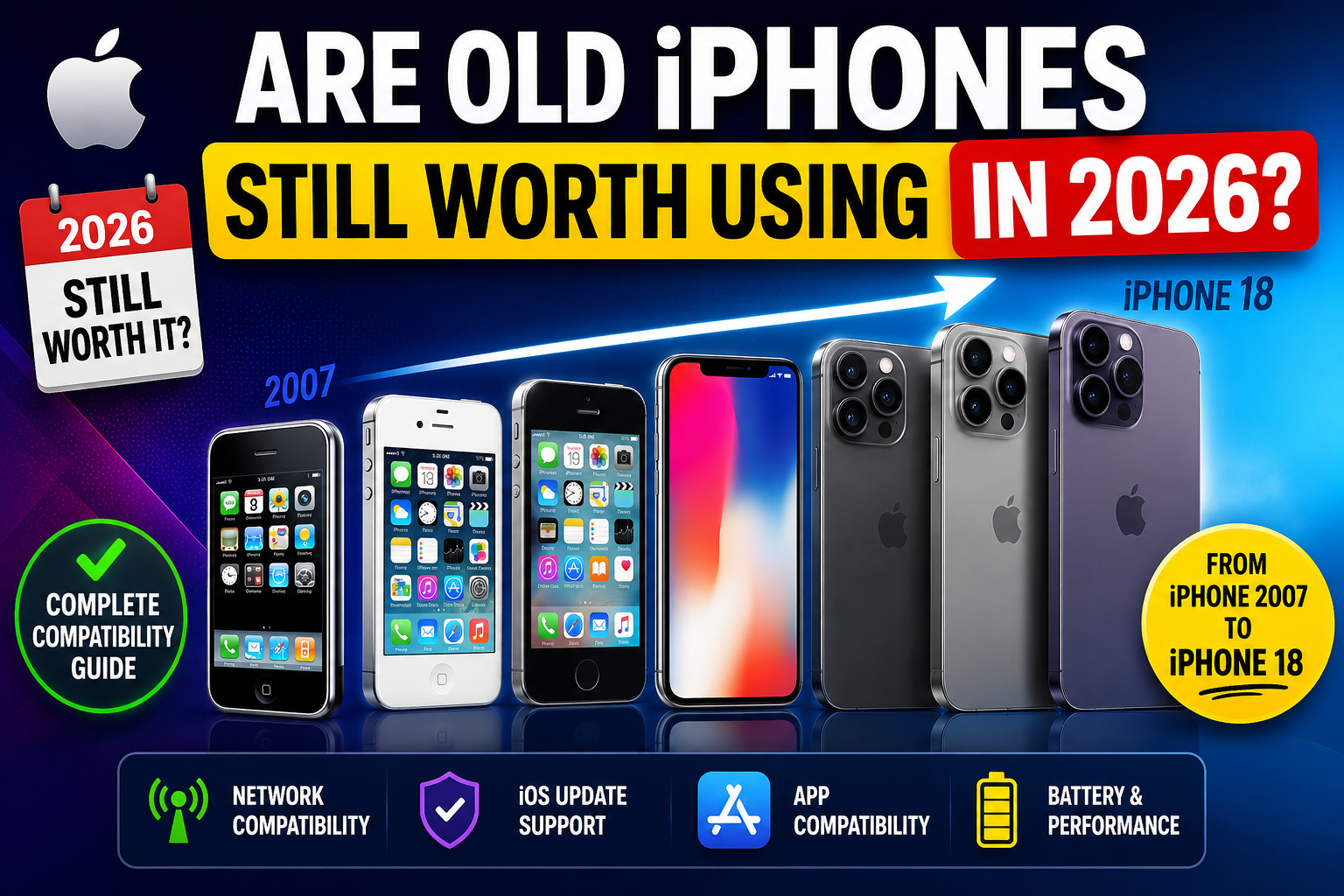
Millions of Americans are still using older iPhones in 2026, raising questions about old iPhone compatibility, iPhone models still receiving updates, and whether an iPhone still supported in 2026 can keep up with modern apps and networks.
If you are wondering:
- What is the oldest iPhone that still works?
- Can you still use an iPhone 8 in 2026?
- Is iPhone X still worth buying in 2026?
- Which iPhones support iOS 26?What apps no longer work on older iPhones?
- How long do iPhones receive updates?
- Should I upgrade from iPhone 11 to iPhone 18?
this guide provides a complete answer.
Based on Apple’s historical iPhone software support years, current iPhone update support list, app requirements, and network changes in the United States, we’ll explain:
- Which iPhones still work in 2026
- The oldest iPhone still usable
- Modern app compatibility
- 5G and carrier compatibility
- Apple software support lifecycle
- Every major feature introduced from the original iPhone to iPhone 18
- Whether upgrading to iPhone 18 makes sense
The Evolution of iPhone (2007–2026)
iPhone Release Timeline and Major Innovations
| 2007 | iPhone | Multi-touch smartphone |
| 2008 | iPhone 3 | GApp Store |
| 2009 | iPhone 3GS | Video recording |
| 2010 | iPhone | Retina Display |
| 2011 | iPhone 4S | Siri |
| 2012 | iPhone 5 | Lightning port |
| 2013 | iPhone 5S | Touch ID |
| 2014 | iPhone 6 | Large displays |
| 2015 | iPhone 6S | 3D Touch |
| 2016 | iPhone 7 | Water resistance |
| 2017 | iPhone X | Face ID |
| 2018 | iPhone XR / XS | Better cameras |
| 2019 | iPhone 11 | Night Mode |
| 2020 | iPhone 12 | 5G connectivity |
| 2021 | iPhone 13 | Improved battery life |
| 2022 | iPhone 14 | Emergency SOS via Satellite |
| 2023 | iPhone 15 | USB-C |
| 2024 | iPhone 16 | Apple Intelligence |
| 2025 | iPhone 17 | AI-focused improvements |
| 2026 | iPhone 18 | Expected next-generation AI |
Which iPhones Still Work in 2026?
iPhones That Still Work in 2026
Fully Recommended:
If you want the best experience in 2026, the iPhone 15, iPhone 16, and iPhone 17 are fully recommended. These models offer excellent performance, long battery life, continued Apple software updates, strong compatibility with modern apps, and full support for 5G networks and AI-powered features. They are expected to remain among the iPhone models still receiving updates for several more years.
- iPhone 15
- iPhone 16
- iPhone 17
Still Excellent:
The iPhone 13 and iPhone 14 remain excellent choices for most users in 2026. Both devices support modern iOS versions, offer reliable performance, and provide compatibility with popular applications such as Instagram, TikTok, Gmail, Zoom, and banking apps. Their strong battery life and 5G capabilities make them ideal for users who want premium features without buying the latest iPhone.
- iPhone 13
- iPhone 14
Usable:
The iPhone 11 and iPhone 12 are still usable in 2026 and continue to satisfy the needs of many users. The iPhone 12 benefits from 5G support, while the iPhone 11 still delivers solid performance for everyday activities such as social media, streaming, video calls, and web browsing. However, these models are closer to the end of Apple’s software support lifecycle, making future upgrade considerations increasingly important.
- iPhone 11
- iPhone 12
Limited but Functional:
The iPhone XR and iPhone XS represent the oldest iPhones still realistically usable in 2026. They can handle basic tasks, including calling, messaging, web browsing, and many common apps, but their aging hardware and limited remaining software support may cause compatibility issues with newer applications and features. For users wondering what is the oldest iPhone that still works, the iPhone XR and iPhone XS are generally considered the practical lower limit.
- iPhone XR
- iPhone XS
Not Recommended:
The iPhone X, iPhone 8, iPhone 7, and older models are not recommended for regular use in 2026. Although some of these devices may still function for calls and light usage, they lack modern security updates, have aging batteries, and may struggle with app requirements and network compatibility in the United States. Many current applications and services increasingly require newer versions of iOS, making these older iPhones less reliable for daily use.
- iPhone X
- iPhone 8
- iPhone 7 and older
How These Rankings Were Determined
These rankings are based on several factors, including Apple’s iPhone update support list, iPhone software support years, aging performance, battery longevity, app requirements by iOS version, network compatibility in the USA, and the availability of Apple software updates. Together, these factors help determine which iPhones still work in 2026 and whether an older device remains practical for everyday use.
Old iPhone Compatibility With Modern Networks in the USA
Why Network Compatibility Matters
Apple has consistently introduced new technologies that have shaped the smartphone industry. From the original iPhone in 2007 to the AI-focused iPhone 18 in 2026, each generation has brought meaningful improvements to design, performance, cameras, connectivity, and intelligence. Understanding these year-by-year iPhone innovations helps explain why some older iPhones remain useful while newer models continue to add capabilities that were once impossible.
2G Shutdown
Most carriers no longer support 2G networks.
3G Shutdown
Major providers including AT&T, Verizon, T-Mobile have shut down 3G service.
VoLTE Support:
VoLTE support has become essential. Older iPhones lacking carrier support may experience Call failures, Poor connectivity, Limited emergency services
5G Compatibility:
5G provides faster speeds,better coverage, lower latency, improved battery efficiency.
Which iPhones Support Modern 5G Networks?
5G iPhone Compatibility
| Model | 5G Support |
| iPhone 12 | yes |
| iPhone 13 | yes |
| iPhone 14 | Yes |
| iPhone 15 | Yes |
| iPhone 16 | Yes |
| iPhone 17 | Yes |
| iPhone 18 | Expected |
Which iPhones Still Receive iOS Updates?
iPhone Models Still Receiving Updates
| Model | Likely Status |
| iPhone XR | Near End |
| iPhone 11 | Suppoted |
| iPhone 12 | Supported |
| iPhone 13 | Supported |
| iPhone 14 | Supported |
| iPhone 15 | Supported |
| iPhone 16 | Supported |
| iPhone 17 | Supported |
| iPhone | Expected to support |
Apple generally provides around 5–7 years of software support, making iPhones among the longest-supported smartphones.
Apps That May No Longer Work on Older iPhones
iPhone Compatibility With Modern Apps
As devices age, some applications require newer iOS versions.
Banking Apps
Many banks require current security standards.
Payment Apps
Apple Pay and digital wallets may become restricted.
Social Media Apps
- TikTok
- Snapchat
Older iPhones can experience reduced compatibility.
Productivity Apps
- Gmail
- Zoom
- Microsoft Teams
AI Applications
Modern AI tools such as ChatGPT and Apple Intelligence features often require newer hardware.
Major Features Introduced Throughout iPhone History
Year-by-Year iPhone Innovations
iPhone 4: Retina Display
Released in 2010, the iPhone 4 introduced the Retina Display, delivering a much sharper screen than previous models. Its high pixel density significantly improved text clarity, photos, and video quality, setting a new standard for smartphone displays.
iPhone 4S: Siri
The iPhone 4S marked the arrival of Siri, Apple’s voice assistant. Introduced in 2011, Siri allowed users to perform tasks, send messages, set reminders, and search the web using voice commands, beginning Apple’s journey into artificial intelligence.
iPhone 5S:Touch ID
Introduced in 2013, the iPhone 5S brought Touch ID, Apple’s fingerprint authentication system. This feature improved device security and made unlocking the phone and authorizing purchases faster and more convenient.
iPhone 7:Water Resistance
The iPhone 7 became Apple’s first mainstream smartphone with water and dust resistance. Released in 2016, it provided greater durability and peace of mind, making accidental splashes and exposure to rain less concerning for users.
iPhone X: Face ID
In 2017, the iPhone X introduced Face ID and eliminated the Home button. Using advanced facial recognition technology, Face ID provided secure authentication and paved the way for the modern edge-to-edge iPhone design.
iPhone 11: Night Mode
The iPhone 11 significantly improved smartphone photography with the introduction of Night Mode. Released in 2019, it enabled users to capture brighter and more detailed photos in low-light conditions without requiring a flash.
iPhone 12: 5G Connectivity
Apple entered the 5G era with the iPhone 12 in 2020. The addition of 5G support provided faster download speeds, lower latency, and better network performance, making the iPhone 12 one of the most important upgrades for users seeking future-proof connectivity.
iPhone 14: Emergency SOS via Satellite
Released in 2022, the iPhone 14 introduced Emergency SOS via Satellite. This feature allows users to contact emergency services in areas without cellular coverage, providing an extra layer of safety for travelers and outdoor enthusiasts.
iPhone 15: USB-C
The iPhone 15 marked a major transition in 2023 with the adoption of USB-C charging. This change improved compatibility with accessories and brought the iPhone in line with many other modern devices, simplifying charging and data transfer.
iPhone 16: Apple Intelligence
In 2024, Apple introduced Apple Intelligence with the iPhone 16 lineup. These AI-powered features enhanced writing assistance, notifications, image generation, and everyday productivity, representing Apple’s most significant software innovation in years.
iPhone 17: Advanced AI Features
The iPhone 17 series, released in 2025, expanded Apple’s focus on artificial intelligence. Improved on-device processing, smarter assistants, and more personalized experiences further strengthened Apple’s AI ecosystem and increased the capabilities available to users.
iPhone 18: Expected AI and Hardware Upgrades
As Apple prepares to launch the iPhone 18 in 2026, industry expectations point toward next-generation AI capabilities, faster processors, enhanced cameras, and deeper integration with Apple Intelligence. While official details remain limited, the iPhone 18 is expected to continue Apple’s emphasis on artificial intelligence and advanced hardware performance.
Why These Innovations Matter
From the Retina Display and Siri to Face ID, 5G connectivity, and Apple Intelligence, each breakthrough has helped define the evolution of the iPhone. These innovations also explain why newer models continue to receive support and why upgrading from very old devices can provide meaningful improvements in performance, security, and compatibility with modern apps and services.
What Happens When Apple Stops Supporting an iPhone?
When Apple ends software support, users may encounter:
Security Risks
No more security patches.
App Incompatibility
Modern apps may stop working.
Battery Problems
Aging batteries reduce performance.
Banking Restrictions
Financial apps may require newer iOS versions.
Slower Performance
Older hardware struggles with demanding applications.
Older hardware struggles with demanding applications.
Should You Upgrade to iPhone 18?Upgrade Decision Matrix
| Current Phone | Upgrade Recommendation |
| iPhone XR | Yes |
| iPhone 11 | Yes |
| iPhone 12 | May be |
| iPhone 13 | Optional |
| iPhone 14 | No |
| iPhone 15 | No |
| iPhone 16 | No |
| iPhone 17 | No |
Best Old iPhones to Buy in 2026
If you’re looking for an older iPhone that still offers strong performance, modern features, and several years of software support, certain models stand out as excellent values. These iPhones continue to work well in 2026, making them attractive choices for budget-conscious buyers who want reliability without paying flagship prices.
iPhone 13
The iPhone 13 remains one of the best-value iPhones to buy in 2026. It offers excellent performance, impressive battery life, reliable cameras, and continued support for future iOS updates. Thanks to its powerful A15 Bionic chip and 5G compatibility, the iPhone 13 can comfortably handle social media, gaming, streaming, and productivity apps, making it one of the best long-term investments among older iPhones.
iPhone 14
The iPhone 14 is an excellent choice for users who prioritize camera quality and battery life. It delivers strong overall performance, supports modern applications, and includes features such as Emergency SOS via Satellite. With several years of Apple software updates still expected, the iPhone 14 offers a premium experience and remains one of the most recommended iPhones that still work in 2026.
iPhone 15
The iPhone 15 is arguably the most future-proof older iPhone available in 2026. Its USB-C port provides greater compatibility with accessories and chargers, while its powerful hardware ensures excellent performance for years to come. Combined with 5G support, advanced cameras, and a long software support horizon, the iPhone 15 represents an outstanding option for buyers seeking modern features without upgrading to the latest iPhone 18.
Frequently Asked Questions (FAQs)
What is the oldest iPhone still usable in 2026?
The iPhone XR and iPhone XS are generally considered the oldest realistically usable iPhones in 2026.
Can an iPhone 8 still be used in 2026?Yes, but only for basic tasks. Many modern apps and features may no longer function properly.
Is iPhone X still worth buying in 2026?No. Limited software support and aging hardware make it difficult to recommend.
Which iPhone supports 5G?
All models from iPhone 12 onward support 5G connectivity.
Which iPhones support iOS 26?
Most recent models, including iPhone 11 and newer, are expected to support iOS 26, while older models are approaching the end of their support lifecycle.
How long do iPhones receive updates?Apple typically offers around five to seven years of software support.
Is iPhone XR still worth buying?
Only if purchased at a very low price. The iPhone 13 provides much better long-term value.
Should I upgrade from iPhone 11 to iPhone 18?
For users interested in Apple Intelligence, improved cameras, and better battery life, upgrading from iPhone 11 to iPhone 18 will likely provide a substantial improvement.



Rishi Sanuj is write article related to Tech and Gadget, Gaming, AI Tools, Software with 8+ years of experience covering PlayStation, and next-gen gaming trends.